AADU vs DADU vs garage conversion: which one is right for your lot?
ADU, AADU, DADU, MIL, backyard cottage, in-law suite, granny flat — half of these mean the same thing, half don't, and contractors use them interchangeably as if you're supposed to already know. Here's what the words mean and which trade-off actually matters for your situation.
This page sorts it out. Glossary first, then a head-to-head on cost, timeline, ROI, and privacy, then a plain "when each one wins" so you can place yourself.
The glossary: what all these words actually mean
ADU — Accessory Dwelling Unit. The umbrella term. Any complete second home on a lot that already has a house: its own kitchen, bath, and entrance. Everything below is a type of ADU.
AADU — Attached Accessory Dwelling Unit. An ADU that shares structure with the main house — a converted basement, a converted attic, or a built addition. "Attached" is the key word.
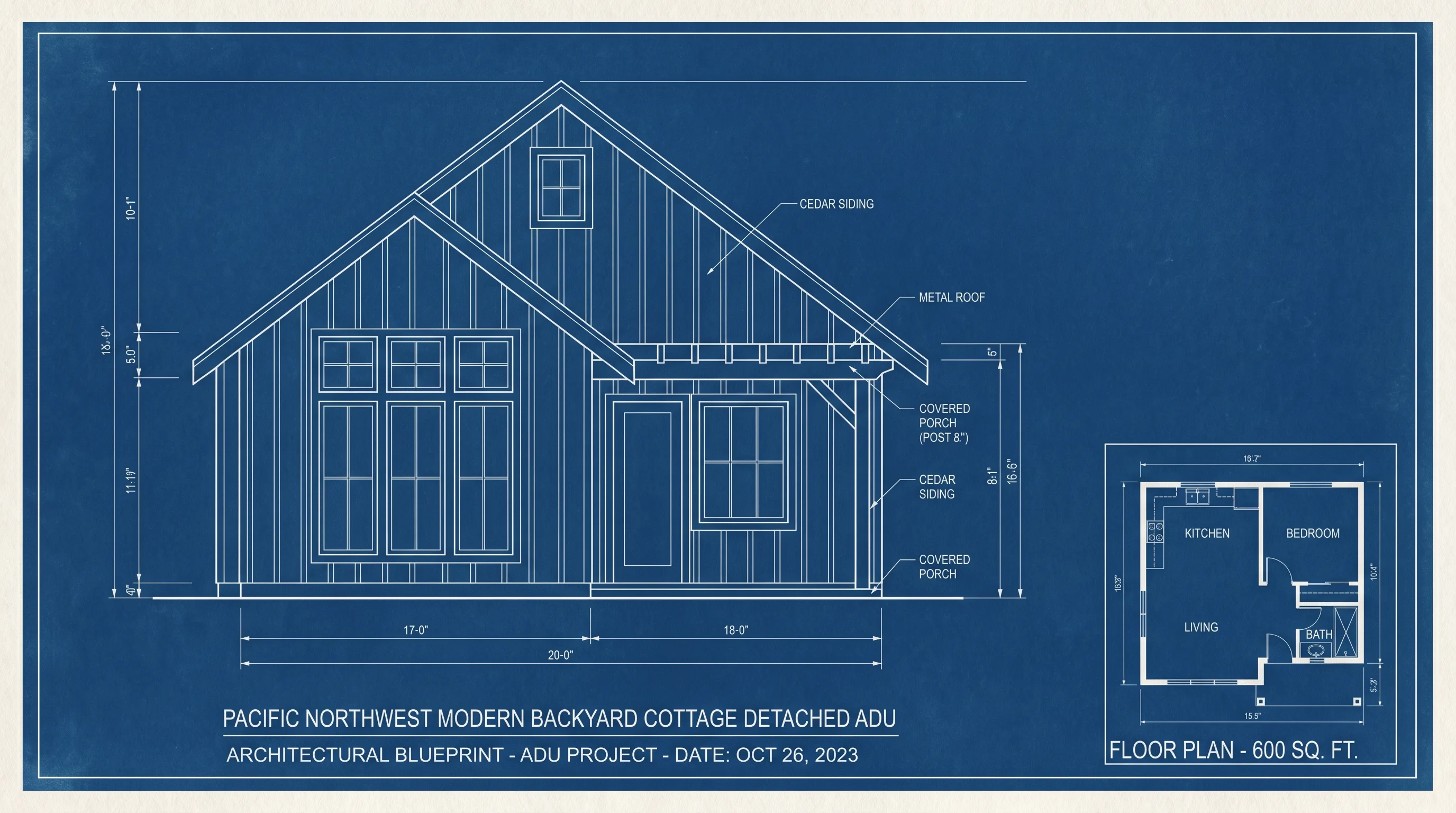
DADU — Detached Accessory Dwelling Unit. A separate, freestanding building on the lot. This is what people mean by "backyard cottage."
Backyard cottage. Seattle's friendly name for a DADU. Same thing. The city's pre-approved plan program is literally called "Encouraging Backyard Cottages."
MIL / mother-in-law suite / in-law apartment / granny flat. Informal names, usually for an AADU (most often a basement conversion) used to house family. Not a separate legal category — just a use case. A "MIL" is typically an AADU; once you add a kitchen and a separate entrance and permit it, it's an ADU.
Garage conversion. Turning an existing garage into living space. It can be either attached (garage under or beside the house → AADU) or detached (standalone backyard garage → DADU). It's a method, not a separate legal type — but the cost profile is distinct enough that homeowners treat it as its own option, so we do too.
The three options at a glance
For this comparison we'll treat the three real decisions homeowners face: garage conversion, basement/attached AADU, and new-build detached DADU.
| Factor | Garage conversion | Basement / attached AADU | New-build DADU |
|---|---|---|---|
| What it is | Convert existing garage | Convert basement or build addition | Freestanding backyard cottage |
| Typical cost | $80K–$350K | $120K–$350K (basement) / $200K–$475K (attached/addition) | $250K–$700K+ |
| All-in cost/sf | $150–$280/sf | $120–$300/sf (basement) | $300–$650/sf |
| Typical timeline | Fastest (less site work) | Moderate (1–3 mo permit) | Longest (full build cycle) |
| Privacy for occupant | Moderate | Lower — shares walls/ceiling | Full — separate structure |
| Rental income | $1,200–$2,200/mo | $1,200–$2,500/mo | $1,800–$3,500/mo |
| Property-value add | Moderate | Moderate | Higher (separate structure) |
| Main risk | Failing slab, electrical upgrade, no parking | Ceiling height, egress, moisture | Utilities, geotech, tree ordinance |
Cost, compared
The cheapest path is almost always converting something you already have.
- Garage conversion — $80,000–$350,000. You already own the structure and the slab, so you skip foundation and most of the shell. The cost lives in MEP ($20K–$45K), interior finishes, and the egress/weatherization upgrades that make a garage habitable. The surprises: a failing or un-insulated slab, an electrical panel that needs upgrading, and the ADU permit/impact fees themselves.
- Basement / attached AADU — $120,000–$475,000. A basement conversion is mid-priced — the shell exists, but PNW basements need serious waterproofing ($8K–$25K), egress windows ($2K–$5K each), and sometimes underpinning for ceiling height. A built addition (attached AADU) costs more because you're building new structure: $250–$500/sf.
- New-build DADU — $250,000–$700,000+. Everything from scratch: foundation, framing, roof, full MEP, plus the big detached-only line items — a new sewer lateral, a separate electrical service, geotech on sloped lots, and tree protection. This is why DADUs carry the highest per-square-foot cost.
See the full cost guide for line-item breakdowns and the hidden costs that hit each type.
Timeline, compared
| Phase | Garage conversion | Basement AADU | New DADU |
|---|---|---|---|
| Permit (custom) | 1–3 months | 1–3 months | 4–8 months (SDCI) |
| Permit (pre-approved) | n/a | n/a | 2–6 weeks |
| Construction | 3–6 months | 4–6 months | 4–9 months |
| Power hookup (Seattle City Light) | varies | varies | up to 6 months |
| Total, realistic | fastest | moderate | 9–18 months |
Conversions move faster because there's no foundation, no new shell, and often no new sewer or power service. A new DADU is the longest path — and Seattle City Light's power-connection queue (up to six months) can stall a DADU that's otherwise finished. A pre-approved DADU plan is the one lever that meaningfully compresses the DADU timeline.
ROI and rental income, compared
A detached DADU rents for the most and adds the most resale value — but it also costs the most and takes the longest. The income spread:
- Garage conversion / basement AADU: $1,200–$2,500/month (studio to 1BR).
- New DADU: $1,800–$3,500/month (1–2BR).
A useful sanity check is the "1% rule" people cite: rent ≈ 1% of build cost per month. A $350K DADU would need to rent for $3,500/month to hit it — the top of the Seattle range — which is why ROI math gets tight on expensive custom builds and looks better on lower-cost conversions.
Two ROI cautions from the field, both real:
- The appraisal gap. Appraisers can't always add your full build cost to your home's value if there aren't recent DADU comps in your neighborhood. People do get caught building $350K of cottage and seeing less than that show up in the appraisal.
- Carrying cost. Twelve to eighteen months of construction-loan interest, plus vacancy and the perpetual King County capacity charge (~$46/month), all eat into the return. Run the real numbers, not just rent-minus-build.
Privacy, compared
This is the factor people under-weight, and it's often the deciding one for family use.
- DADU — full privacy. Separate building, separate entrance, no shared walls. Best for aging parents who want independence, adult children who need their own space, or tenants who'll pay more for it. Also the easiest to downsize into — move to the cottage, rent the big house.
- Basement / attached AADU — lowest privacy. Shares a wall, ceiling, or floor with the main house. You'll hear each other. Fine for close family, harder for arm's-length tenants. Sound isolation and a genuinely separate entrance matter a lot here.
- Garage conversion — in between. Depends entirely on whether the garage is attached or detached. A detached backyard garage converts to near-DADU privacy; an attached one is closer to an AADU.
When each one wins
Build a garage conversion if:
- You have a structurally sound garage already.
- Budget is the binding constraint — this is the cheapest path to a legal unit.
- You can live without that garage parking (HB 1337 removed parking minimums near transit, so the city won't force a replacement).
- Speed matters — it's the fastest option.
Build a basement / attached AADU if:
- You have usable basement space or room to add on.
- The unit is mainly for family (a true "MIL" suite) and shared walls are acceptable.
- You want a mid-priced unit and your ceiling height and moisture situation are workable.
- You want to pair it with a future DADU for two income units.
Build a new detached DADU if:
- Privacy and rental income are the priority — it earns the most and adds the most value.
- You're housing aging parents who want independence, or downsizing into the cottage yourself.
- Your lot has buildable backyard space and reasonable access for construction.
- You can absorb the higher cost and longer timeline, and ideally use a pre-approved plan to speed permitting.
Not sure which fits your lot? That's a site-and-budget question, and it's the first thing we figure out — before you commit to anything. See real costs by type → · What HB 1337 lets you build →
"ADU" is the umbrella term for any second dwelling on your lot. A "DADU" is the detached kind — a freestanding backyard cottage. An attached one (basement, addition) is an "AADU." All DADUs and AADUs are ADUs.