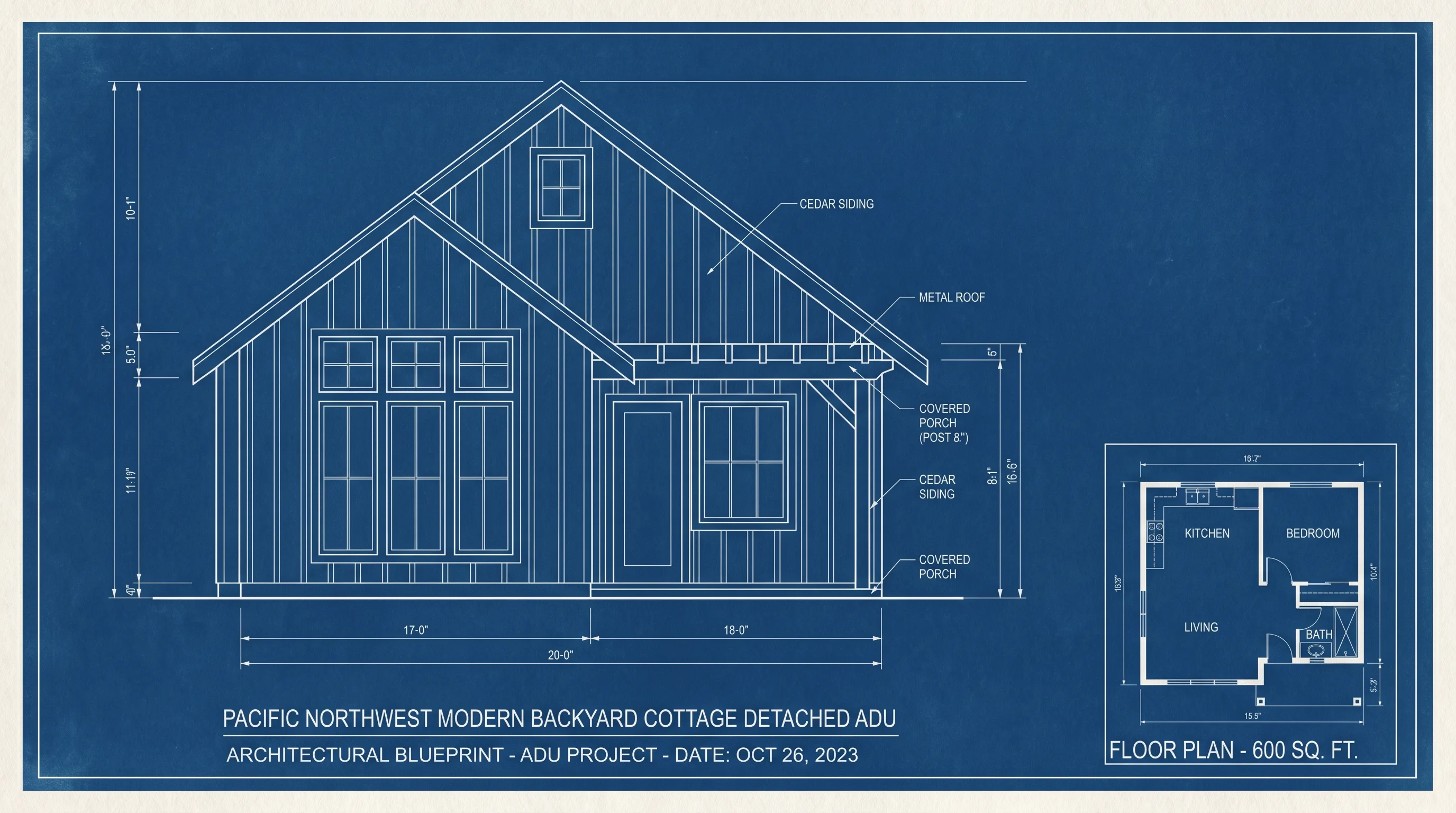
HB 1337, in plain English: what actually changed for your King County lot
The state pages tell you a bill passed. The city pages bury the part you care about under nine clicks of code citations. Neither answers the question you actually have: can I build, do I have to live here, and where's the catch.
HB 1337 is a 2023 Washington State law that forced every city and county in the urban parts of the state to loosen their ADU rules. The deadline to comply was June 30, 2025. By now Seattle, Bellevue, Kirkland, Renton, and the rest of King County have all rewritten their codes to match it. The law overrides local zoning — it does not override everything, and the difference is where most people get tripped up.
The five things HB 1337 changed
1. Owner-occupancy is gone
Before: In most King County cities you had to live on the property to have an ADU. That rule killed a lot of plans — investors couldn't do it, and owners who wanted to move out later were stuck.
Now: No owner-occupancy requirement, anywhere HB 1337 applies. You can build a DADU, rent both the main house and the cottage, and live somewhere else. Seattle actually dropped this rule back in 2019; the rest of the state caught up under HB 1337.
2. Parking minimums are barred near transit
Before: Cities could force you to add an off-street parking space for the ADU. On a tight lot, that one requirement could make a project impossible — or push the cottage into the only buildable corner.
Now: Cities cannot require off-street parking for an ADU within a half-mile of major transit. Eliminating a required parking pad saves roughly $5,000–$15,000 depending on site work. A few cities (Seattle, Sammamish in parts) dropped parking minimums entirely; most others waive the requirement near transit and keep one space elsewhere. See the table below for your city.
3. Two ADUs per lot
Before: One ADU per lot was the norm.
Now: Up to two ADUs per lot across King County's urban areas. That means you can pair a basement AADU with a backyard DADU on the same property — two income units, or one for family and one to rent. (Rural unincorporated King County is the exception: one ADU, and only if your lot meets a minimum acreage.)
4. You can sell the ADU separately (condoization)
Before: An ADU was legally welded to the main house. You owned one parcel; you sold it as one parcel.
Now: HB 1337 legalized condoization — splitting the ADU into a separately owned, separately sellable unit (RCW 36.70A.681(1)(h)). This is the headline change for investors. The catch: the legal and survey paperwork to actually do it runs $30,000–$50,000 (roughly $2,000 for the survey, $5,000–$10,000 for the attorney, plus the condo/HOA structure), and it can trip a due-on-sale clause depending on your loan. It is now legal everywhere the law applies. It is not free or automatic.
5. Impact fees are capped at half
Before: A new ADU could get hit with the full impact-fee schedule a brand-new single-family house would pay.
Now: ADU impact fees are capped at 50% of what a new single-family home would be charged. School impact fees, the biggest line, are roughly $7,400 per DADU and $3,700 per attached ADU in the Seattle School District under this cap. They're real money — just half of what they used to be.
What HB 1337 did not change
This is the part the law pages don't put in bold, and it's where projects die.
- It does not override your HOA.The law preempts city zoning, not private covenants (CC&Rs). If your neighborhood has a recorded covenant banning ADUs, your HOA can still enforce it. The city won't — but your neighbors can.
- It does not legalize short-term rentals. No owner-occupancy does not mean unlimited Airbnb. STR rules are separate and local — Seattle limits short-term rentals to your primary residence; Kirkland requires you to occupy 245 days a year; Bellevue effectively bans them in single-family zones.
- It does not make permits instant. Even a pre-approved plan goes through site-specific review. The bottleneck moved from zoning to civil infrastructure — sewer capacity, septic, utility hookups, and labor. Seattle City Light's power-connection queue alone has run as long as six months.
- It does not waive the hidden costs. Sewer connections, geotech reports, the King County wastewater capacity charge (a perpetual ~$46/month bill), and Seattle's new 2026 utility charges all still apply. See our cost guide for the full list.
City-by-city: how HB 1337 landed in your jurisdiction
Every King County city had to meet the same floor. Most went a little further, and a few quirks matter for your budget and timeline. Figures below are from each jurisdiction's adopted code as of 2025–2026.
| City | Max ADUs | Owner-occupancy | Parking | Max DADU size | Height | Pre-approved plans | What's distinctive |
|---|---|---|---|---|---|---|---|
| Seattle | 2 | Removed | None required | 1,000 sf | 18–24 ft | Yes — ADUniverse | Shoreline overlay (within 200 ft of water) adds 4–8 weeks and $5K–$15K; King County capacity charge applies |
| Bellevue | 2 | Removed (2024) | 1 (waived near transit) | 1,000 sf | 24 ft | Drafting (~2027) | Geotech common east of 148th Ave; Bridle Trails lot-coverage quirk shrinks the buildable area |
| Kirkland | 2 | Removed | 1 (waived near transit) | 1,200 sf | 25 ft | Yes (~$1,000 license) | Largest allowed DADU in King County; reduced alley setbacks |
| Redmond | 2 | Removed | 1 (waived near transit) | 1,000 sf | 24 ft | None | Mandatory construction-waste reporting before final inspection |
| Renton | 2 | Removed | 1 (waived near transit) | 1,000 sf | 24 ft | Yes — PRADU, free, 8 plans | Converts non-conforming garages; one-on-one staff review; historic fee waivers |
| Kent | 2 | Removed | 1 (waived near transit) | 1,000 sf | 23 ft ⚠️ | Yes | Shared utilities allowed — can save ~$40,000 vs. separate connections |
| Auburn | 2 | Removed | 1 (waived near transit) | 1,000 sf | 24 ft | — | 3-year property-tax exemption on the value the ADU adds; garage conversions must re-finish the exterior to match |
| Federal Way | 2 | Removed | 1 (waived near transit) | 1,000 sf | 16 ft ⚠️ | None | Custom permits ~60 days; 10 ft separation or fire-rated wall; sprinklers if the nearest hydrant flows under 1,750 gpm |
| Sammamish | 2 | Removed | None near transit | 1,000 sf (AADU up to 50% of main home) | 24 ft | None | School impact fee $10,914/unit — budget for it; ADU is excluded from floor-area ratio |
| Unincorp. King County | 2 (urban) / 1 (rural) | Removed | None | 1,000 sf heated + 1,000 sf unheated | 24 ft | None | Rural needs minimum acreage (RA-2.5 = 1.875 ac); septic and Public Health review; permit fees up 49% since Jan 2025 |
The five misconceptions homeowners get wrong
These come up constantly on Reddit and in the forums. Each one is false, and believing it costs people money or kills good projects.
Misconception 1: "State law overrides my HOA."
False. HB 1337 preempts city zoning. It does not touch private CC&Rs. If your neighborhood has a recorded covenant restricting ADUs, it's still enforceable — by your neighbors, not the city. Check your CC&Rs before you spend a dollar on design. Covenant fights are live right now in Somerset, Bridle Trails, and parts of Sammamish.
Misconception 2: "Pre-approved plan = instant permit."
False. A pre-approved plan (Seattle's ADUniverse, Renton's PRADU, Kirkland's catalog) skips the design-review queue and can cut permitting to 2–6 weeks instead of 4–8 months. But the city still does site-specific review — geotech, drainage, utilities, tree protection. A pre-approved plan on a steep or constrained lot can still require modifications. It's a fast lane, not a teleporter.
Misconception 3: "I have to install separate meters."
False. State law bars cities from requiring separate water, sewer, or electric meters for an ADU. Kent actively encourages shared utilities — and sharing instead of running new separate connections can save around $40,000. (Your power utility may still want a separate electrical service for a detached unit; that's a utility-coordination question, not a zoning requirement.)
Misconception 4: "No owner-occupancy means unlimited Airbnb."
False. Dropping owner-occupancy is a zoning change. Short-term-rental rules are separate and still restrictive. Seattle limits STRs to your primary residence. Kirkland requires 245 days of owner occupancy for an STR. Bellevue effectively bans them in single-family zones. If your whole plan is "build a DADU and Airbnb it," check the STR ordinance in your specific city first.
Misconception 5: "My illegal/non-conforming garage can't be converted."
False. HB 1337 forces cities to allow the conversion of legal non-conforming structures into ADUs without bringing them up to modern setback rules. That old garage sitting three feet from the property line can often become a legal ADU — exactly because it predates the current setbacks. Renton and several other cities explicitly allow converting non-conforming garages.
This guide explains the law in general terms. Your lot's specifics — overlays, covenants, slope, utilities — decide what you can actually build. We check those for you before you commit to anything. See the cost guide → · AADU vs DADU vs garage conversion →
Up to two ADUs per lot, no owner-occupancy requirement, no parking minimums near major transit, ADU impact fees capped at 50% of single-family rates, separate sale (condoization) permitted, and dimensional/aesthetic standards roughly in parity with the main home. Every King County city had to meet this floor by June 30, 2025.