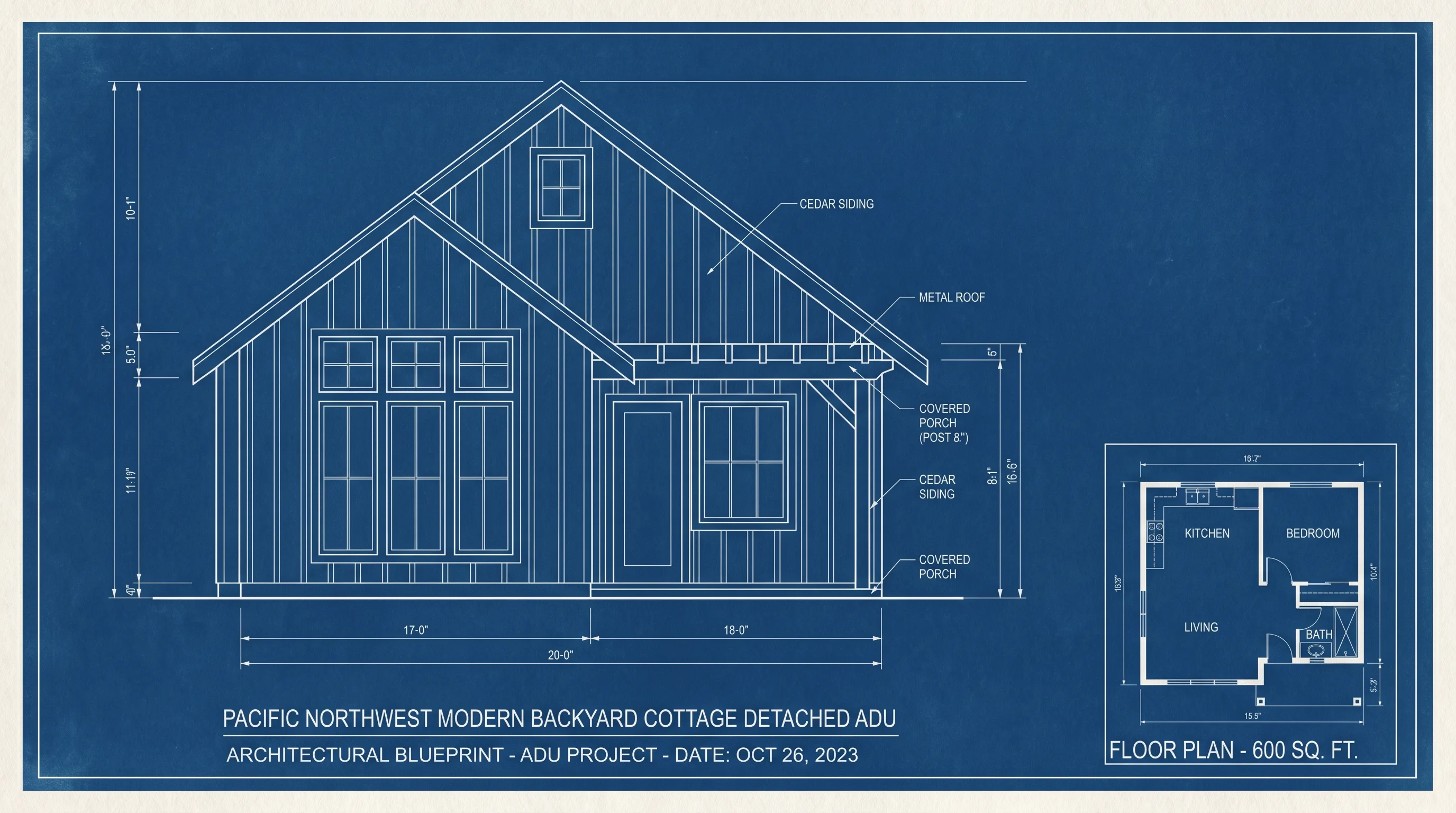
A backyard rental for financial breathing room
You want income to offset the mortgage without becoming a full-time landlord — and you need it to actually pencil out. Here are the real Seattle rent numbers and an honest break-even sketch, including where it doesn't work.
If you're here, the question in your head is some version of “is it actually worth it after the loan payment?”That's the right question. Most builder blogs answer it with a projection where everything goes perfectly. This page gives you the numbers and the math both ways — so you can decide whether a rental ADU buys you breathing room or just a second mortgage.
The situation
Seattle's cost of living and mortgage pressure push a lot of homeowners toward the same idea: turn the backyard into cash flow. The fear underneath it is just as common — “I'll build it and it'll sit empty”, and “the ROI math will turn out to be wrong.” You want passive income without the obligations of being a real landlord, and you want to know the break-even before you commit six figures.
What it rents for
Real Seattle ADU rents, by unit type:
| Unit | Monthly rent |
|---|---|
| Studio / small basement | $1,200–$1,600 |
| 1-bedroom DADU | $1,600–$2,500 |
| 2-bedroom DADU | $2,500–$3,500 |
A 1-bedroom DADU is the volume play — it rents reliably and costs less than a 2-bedroom to build. If you have the space and the budget, a 2-bedroom captures the top of the range. A studio or basement unit is the cheapest path in, with the thinnest rent.
Which format fits this goal
For pure rental income, a detached DADU usually wins: better tenant privacy, higher rent, and a separate structure that adds the most to a future sale. It costs the most and takes the longest — a new detached build runs $250K–$700K+ in Seattle and 9–18 months end to end.
If your priority is the lowest build cost and you have an existing structure, a garage conversion ($80K–$350K) or a basement AADU($225K–$475K) gets you a rentable unit faster and cheaper, at the cost of lower rent and shared walls. The cheapest unit isn't automatically the best return — run the rent-to-cost ratio for each.
Does it pencil? An honest break-even sketch
Investors use the 1% rule as a sanity check: monthly rent should be about 1% of build cost. For that to hold, a $350,000 DADU would need to rent for $3,500/month— the very top of the Seattle market, realistic only for a well-located 2-bedroom. Most builds don't hit it. That doesn't make them bad; it makes them long-horizon, not instant cash machines.
Take a $350,000 detached DADU renting at $2,200/month (a reasonable 1-bedroom):
- Gross rent: ~$26,400/year
- Minus vacancy, repairs and reserves, and any management — call it 20–25% off the top
- Minus your financing cost during and after construction
The honest takeaway: at current rents and build costs, a fully financed Seattle rental ADU is rarely cash-flow-positive in the early years. It works as a long-term equity and income play— you're buying an appreciating, income-producing asset on your own land — not as a quick return. And budget for the line items that never show up in the first quote: soft costs (design, permits, utilities) add 15–20% on top of construction, plus a King County sewer capacity charge and a Seattle City Light hookup wait of up to six months on detached builds.
The risk worth naming: vacancy
A widely-shared Reddit thread is bluntly titled “No one wants to live in your DADU.”It's not wrong to raise the point. Rental projections assume immediate, continuous occupancy. If your neighborhood's small-unit market is soft, or your unit is a windowless basement studio, you may sit vacant — and a vacant ADU is two mortgages. Check actual comps for your neighborhood and your unit size before you build.
Keep reading
Is an ADU worth it in Seattle? →walks the full ROI math across rental, multigen care, and resale. When you're ready to test your own lot, run the feasibility check → for a planning cost range and what your city allows.
Roughly $1,600–$2,500/month for a 1-bedroom detached DADU, $1,200–$1,600 for a studio or small basement unit, and $2,500–$3,500 for a 2-bedroom — before vacancy, repairs, and financing costs. Check comps for your specific neighborhood and unit size, not the citywide average.